Prebiotics vs Probiotics, What Should I Choose?

Have you heard of prebiotics, probiotics and wondered what they mean or which one is right for you? In this article, we will explain the differences between these two terms and guide you in finding the right option for your health needs.
What are prebiotics?
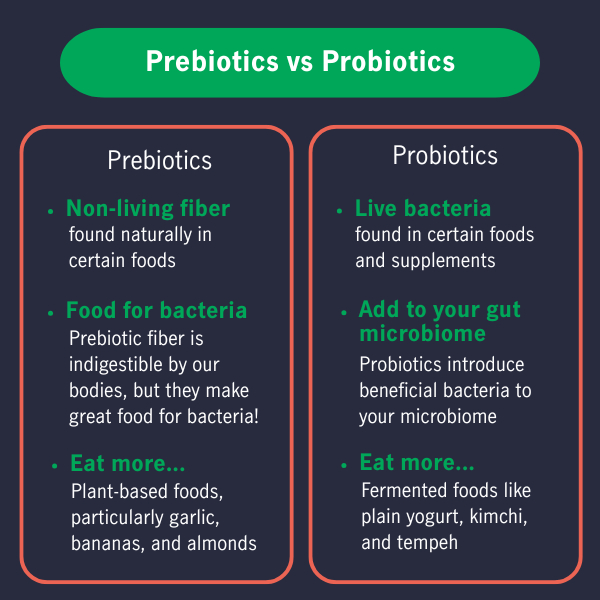
Prebiotics are food for beneficial bacteria in your gut microbiome, and these beneficial bacteria are called probiotics.
In general, prebiotics can be found in everyday fruits and vegetables, such as potatoes and carrots, in the form of plant fibers and resistant starch. Do note, though, that not all dietary fibers are prebiotic.
What are probiotics?
Probiotics are a group of bacteria that are beneficial to humans. Probiotic microbes such as Bifidobacteria and Lactobacillus promote intestinal cell health and help maintain a healthy balance in your gut by keeping harmful bacteria in check.
Common probiotic-containing foods are yogurt, kombucha, and kimchi. You can also take probiotic supplements.
Why do you need both prebiotics and probiotics?
Prebiotics and probiotics work in harmony to enhance your overall gut microbial diversity. Prebiotics help to grow and activate your gut bacteria, protect them from being destroyed, and increase the beneficial bacteria in your gut.
Taking probiotic supplements can increase the beneficial bacteria in your gut rapidly while limiting the growth of harmful bacteria. This aids in restoring and maintaining the stability of your gut microbiome.
However, as with any food product, eating too much may still cause adverse effects.
How to manage your nutrition?
Understanding your microbiome status can help develop personalized nutrition plans. For example, if you went through antibiotic treatment, probiotics would help to restore your natural gut microbiome balance. If you have irregular stools or bloating, prebiotics will help to feed good bacteria in your gut.
Prebiotics are ideally consumed from fresh food such as garlic, onions, leeks, asparagus, bananas, barley, oats, apples, cocoa, and seaweed.
Probiotics can be consumed in the form of fresh food or supplements. Food items containing probiotics are yogurt, sauerkraut, tempeh, kimchi, miso, kombucha, pickles, and some cheeses.
Remember, it is possible to assess your gut microbiome status by taking gut microbiome tests. These tests will help you to understand your gut microbiome status and how it’s affecting your physical as well as mental health. By designing personalized nutrition plans based on the assessment, you will be able to achieve your nutrition goals faster.
As a Manulife customer, you’re entitled to an exclusive 20% discount on AMILI’s gut microbiome test, which also includes a doctor consultation to help you interpret your results and take meaningful steps toward better health. Go to the My Rewards section in your ManulifeMOVE dashboard to learn how to redeem your discount.
Sources
References
- Aragon, G., Graham, D. B., Borum, M., & Doman, D. B. (2010). Probiotic therapy for irritable bowel syndrome. In Gastroenterology and Hepatology (Vol. 6, Issue 1, pp. 39–44). Millenium Medical Publishing.
- Ashaolu, T. J. (2020). Immune boosting functional foods and their mechanisms: A critical evaluation of probiotics and prebiotics. Biomedicine & Pharmacotherapy.
- Chen Li, Z. N. (2020). Probiotics, prebiotics, and synbiotics regulate the intestinal microbiota differentially and restore the relative abundance of specific gut microorganisms. Journal of Dairy Science, 5816 – 5829.
- Chung W.S.F., Walker A.W., Louis P., Parkhill J., Vermeiren J., Bosscher D., Duncan S.H., Flint H.J. Modulation of the human gut microbiota by dietary fibres occurs at the species level. BMC Biol. 2016;14:1–13.
- Kolodziejczyk, A. A., Zheng, D., & Elinav, E. (2019). Diet–microbiota interactions and personalized nutrition. In Nature Reviews Microbiology (Vol. 17, Issue 12, pp. 742–753). Nature Publishing Group.
- Markowiak, P., & Ślizewska, K. (2017). Effects of probiotics, prebiotics, and synbiotics on human health. In Nutrients (Vol. 9, Issue 9). MDPI AG.
- Prebiotics – International Scientific Association for Probiotics and Prebiotics (ISAPP). Retrieved 30 October 2020, from
- Probiotics – International Scientific Association for Probiotics and Prebiotics (ISAPP). Retrieved 30 October 2020, from
If you liked this article, you may find these interesting



Thank you, {FirstName}, for sharing your contact details with Manulife!
We will be contacting you to talk about your inquiry.

Oops! There seems to be a problem.
Please review the form and make sure you filled out all the necessary details.

Manulife Philippines is regulated by the Philippine Insurance Commission and is authorized to provide financial products or services in the Philippines.
Copyright © 2020, The Manufacturers Life Insurance Company and its subsidiaries. All rights reserved. Main office: 10th Floor NEX Tower, 6786 Ayala Avenue, Makati City, 1229 Tel : +632 8884 7000, Toll-free: 1-800-1-888-6268